Greetings · Beginner
How to say hello in Chinese

By Xinyao, Mandarin teacher
MA TESOL, University of Glasgow · · 6 min read
你好
nǐ hǎo
hello
The safest first greeting. The first syllable changes when you say it aloud.
Useful greetings
你好 is the safe first hello
The first greeting I teach is 你好 (nǐ hǎo, hello). The two characters are 你 (nǐ, you) and 好 (hǎo, good). Together they make the familiar greeting that works when you meet someone for the first time.
When my students start Mandarin, they often want a longer phrase. I ask them to use 你好 first and save the extra words for later. A short greeting said clearly is more useful than a long sentence you are afraid to say.
Use 你好 with a new classmate, a shop assistant, a neighbour, or someone you are meeting at an event. It is a good default when you do not yet know the relationship or the right level of formality.
If you are starting from zero, this small phrase is a good first win. I also explain the bigger picture in Is Mandarin hard to learn?, including why pronunciation feels strange at the beginning.
Learn this with Xinyao in a small live class. Term 1 starts 14 October.
See the classHow to pronounce 你好
The written pinyin is nǐ hǎo. The mark over each vowel shows a third tone. For a third tone, your voice moves low and then rises. You do not need to make a huge performance out of it. Start with a relaxed voice and let the important movement happen naturally.
There is one pronunciation detail worth learning early. When two third tones come together, the first one is normally said as a rising second tone. That means 你好 is written nǐ hǎo, but in an ordinary sentence it sounds like ní hǎo.
You can practise it in two steps: say nǐ on its own, then say hǎo on its own. Put them together without stopping and let the first syllable rise. The result should feel like ní hǎo, not two deep dips in a row.
I usually have students say the word slowly first, then at a normal speaking speed. If the tone change disappears when the phrase gets faster, I return to the two separate syllables and join them again. This is a small adjustment, not a reason to start over.
你
nǐ
third tone
好
hǎo
third tone
你
rises in the phrase
好
hǎo
stays low then rises
When to say 您好 or 大家好
For a more polite hello, use 您好 (nín hǎo, hello). You might choose it when you greet a teacher, an older person, or someone you want to address with extra respect. If you are unsure, 您好 is a safe choice in a formal first meeting.
The difference between 你好 and 您好 is not a different kind of hello. 您 is the polite form of 你, so the second greeting keeps the same 好. Listen for the rising sound in nín and then say hǎo after it.
When you are speaking to a group, say 大家好 (dàjiā hǎo, hello everyone). 大家 means everyone, and 好 is the same good or well from 你好. It is a natural way to open a class, a meeting, or a group video call.
You do not need to choose all three at once. One person in a casual setting can get 你好. One person in a formal setting can get 您好. A room full of people can get 大家好.
How to ask how someone has been
Many beginner books introduce 你好吗 (nǐ hǎo ma, how are you?). It is understandable, and you can use it when you are practising a lesson. In a real conversation, the most natural question depends on the person and the situation.
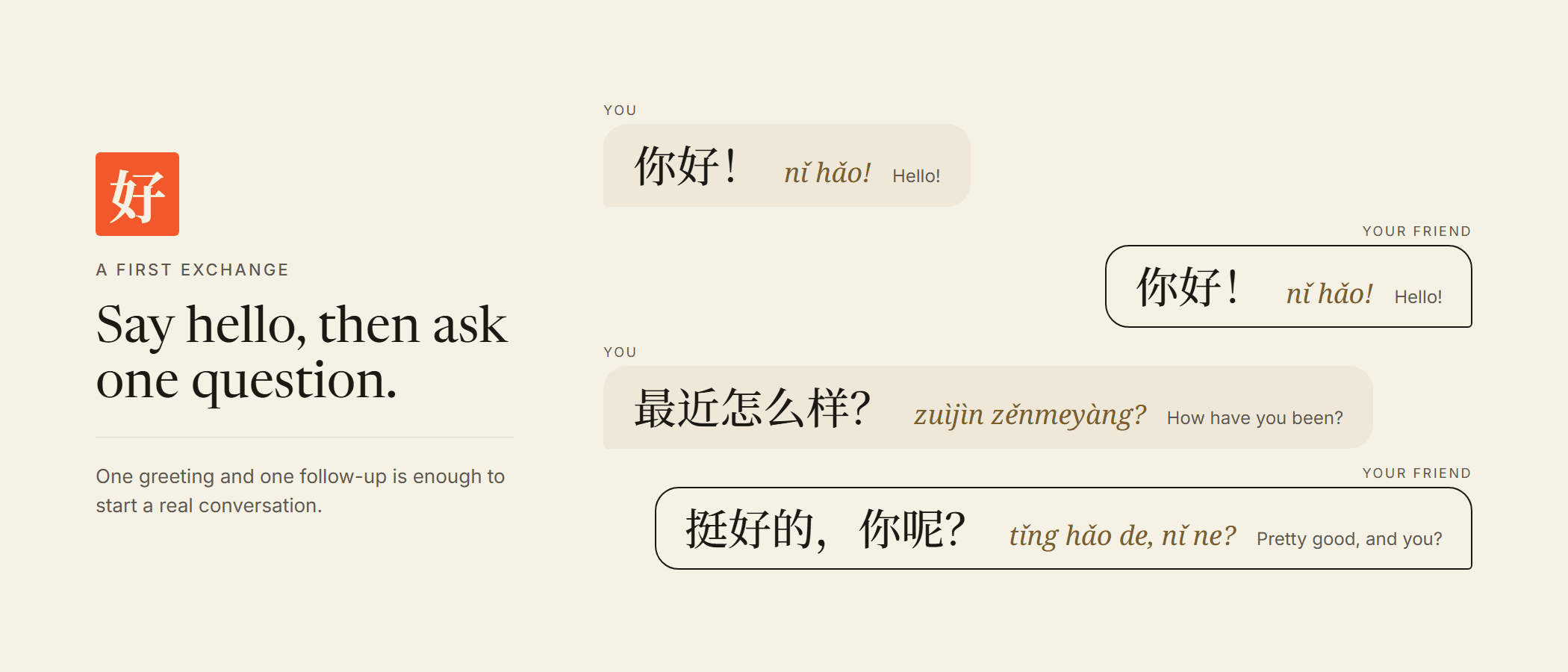
With someone you already know, 最近怎么样 (zuìjìn zěnmeyàng, how have you been?) is a useful choice. 最近 means recently, and 怎么样 means how is it. The question gives the other person room to tell you what has happened lately.
You may also hear 吃了吗 (chī le ma, have you eaten?). The words are 吃, eat, 了, a marker for a completed situation, and 吗, which turns a statement into a question. Depending on the context, it can work as a warm check-in rather than an actual request for a meal.
My advice is to learn one greeting and one follow-up instead of memorising a whole conversation. Start with 你好. When that feels comfortable, add 最近怎么样 and listen to the answer before you plan your next sentence.
Good morning, hi, and hello on the phone
For good morning, say 早上好 (zǎoshang hǎo, good morning). 早上 means morning, so the phrase is easy to remember once you know 你好. It is useful at the start of a morning class or when you meet someone early in the day.
For a very casual hi, 嗨 (hāi, hi) sounds familiar because it is a borrowed sound. You are more likely to use it with a friend, in a message, or in a relaxed conversation. If you need one greeting that works in more situations, return to 你好.
On the phone, 喂 (wéi, hello?) is the word you use when you answer. It is not the general greeting to use when you walk into a room. Keep it for a telephone conversation, then move on to the reason for your call.
A simple morning exchange could be 早上好, followed by 今天怎么样 (jīntiān zěnmeyàng, how is today going?). With a friend you have not seen for a while, 你好 and 最近怎么样 will sound more useful than repeating a textbook question.
Questions people also ask
How do you say how are you in Chinese?
You can say 你好吗 (nǐ hǎo ma, how are you?), especially while practising. With someone you know, 最近怎么样 (zuìjìn zěnmeyàng, how have you been?) is a more useful everyday question.
How do you say hi, how are you in Chinese?
Use 嗨 (hāi, hi) for a casual opening, then ask 最近怎么样 (zuìjìn zěnmeyàng, how have you been?). Use 你好 (nǐ hǎo, hello) instead of 嗨 when you want a safer greeting.
How do you say good morning in Chinese?
Say 早上好 (zǎoshang hǎo, good morning). It is a morning greeting, so you do not need to use it at every time of day. For a general hello, say 你好 (nǐ hǎo).
How do you reply to 你好?
Say 你好 back. That is enough for the first exchange. If the person used 您好 (nín hǎo, polite hello), you can reply with 您好 when the situation feels formal.
How do you say hello in Cantonese?
Cantonese also writes 你好, but the Cantonese pronunciation is nei5 hou2. The characters are shared, while the sounds differ. See Cantonese vs Mandarin.