Chinese varieties · Beginner
Cantonese vs Mandarin: what is the difference?

By Xinyao, Mandarin teacher
MA TESOL, University of Glasgow · · 7 min read
普通话 vs 广东话
Pǔtōnghuà vs gwong2 dung1 waa2
Mandarin vs Cantonese
The characters can look familiar while the spoken sounds change.
Cantonese starter words
Cantonese and Mandarin are not the same spoken language
Cantonese and Mandarin are both varieties of Chinese, but they do not sound the same. Mandarin is 普通话 (Pǔtōnghuà, Mandarin), and Cantonese is 广东话 (gwong2 dung1 waa2, Cantonese) in the terms used here. The names tell you that you are comparing two ways of speaking, not two accents of one conversation.
If you speak Mandarin, you may recognise a few Cantonese words or guess a topic from context. That does not mean you can follow a whole spoken conversation. The sound system, tones, and many everyday words are different enough that a beginner in one variety needs to study the other.
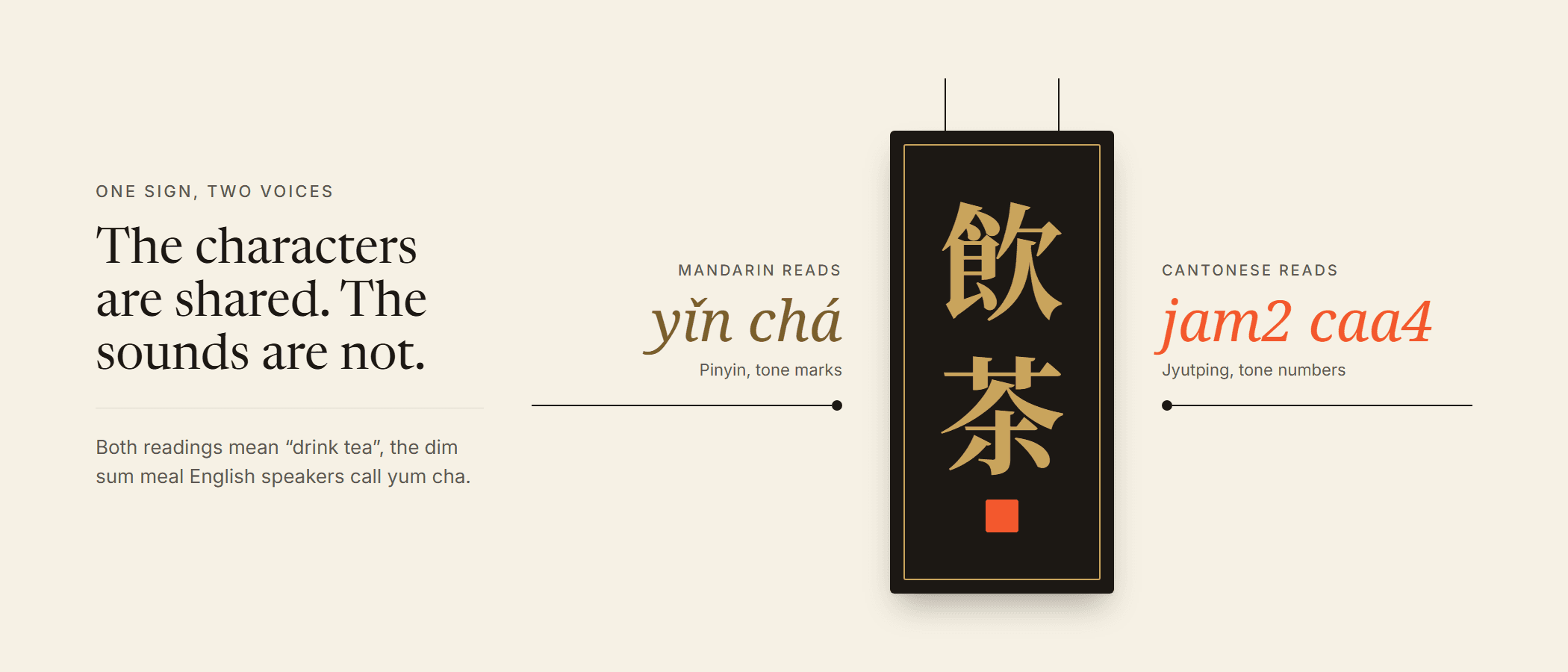
The confusing part is writing. A Mandarin speaker and a Cantonese speaker may recognise the same characters in a sign, even when they read them with different sounds. 你好 means hello in both written forms, but Mandarin says nǐ hǎo while Cantonese says nei5 hou2.
If your goal is Mandarin, begin with the sounds you will actually use. How to say hello in Chinese starts with Mandarin greetings, and Is Mandarin hard to learn? explains how to approach the first unfamiliar parts.
Learn this with Xinyao in a small live class. Term 1 starts 14 October.
See the classWhy the same characters sound different
Take 你好 as a small example. In Mandarin, it is nǐ hǎo, with tone marks. In Cantonese, it is nei5 hou2, with Jyutping tone numbers. The characters give you a visual connection, but the letters and numbers show that your mouth and voice have a different job in each variety.
Mandarin pinyin uses marks such as ā, á, ǎ, and à to show tone movement. The Jyutping system used for Cantonese writes a number after each syllable, such as nei5 hou2. The systems are spelling guides, not a promise that a Mandarin tone number can be swapped directly for a Cantonese one.
The difference becomes clear in a familiar phrase. Cantonese 多謝 (do1 ze6, thank you) does not use the Mandarin sounds duōxiè, even though the characters may be recognisable. In Cantonese, you learn the phrase as its own sound, just as you would learn a new English word instead of translating each letter.
When I compare languages for a beginner, I keep the written connection and the spoken difference in view at the same time. One can help you remember the meaning. The other still needs careful listening and practice.
| Written form | Mandarin | Cantonese | English |
|---|---|---|---|
| 你好 | nǐ hǎo | nei5 hou2 | hello |
| 多謝 | duōxiè | do1 ze6 | thank you |
| 中文 | Zhōngwén | zung1 man4 | Chinese language |
Is Cantonese Chinese?
Yes. Cantonese is a Chinese variety, and 廣東話 (gwong2 dung1 waa2, Cantonese speech) is one way to name it in Cantonese. Saying that Cantonese is Chinese does not mean that it is identical to Mandarin. The same broad label can include spoken varieties with different sounds and vocabulary.
A useful comparison is to separate three questions: how does it sound, how is it written, and where will I use it? Two speakers may recognise the same character, choose different words in conversation, and pronounce a sentence differently. A written connection answers only one of those questions.
For example, 食飯 (sik6 faan6, eat a meal) and 飲茶 (jam2 caa4, drink tea) are useful Cantonese phrases to learn as phrases. You can notice the characters, but do not assume that reading them with Mandarin sounds will produce Cantonese. Listen for the whole expression.
When someone says they are learning Chinese, ask what they want to do with it. They may mean Mandarin conversation, Cantonese with family, reading, or a mixture. The best first materials depend on that answer.
Is Mandarin the same as Chinese?
Mandarin is not the same as every meaning of Chinese. 普通话 (Pǔtōnghuà, Mandarin) names the spoken target in this article. 中文 (Zhōngwén, Chinese language) is a broader everyday term. People often use Chinese when they mean Mandarin, especially in a beginner course, but the wider label can include other varieties.
Most beginner resources that say Chinese are teaching Mandarin pronunciation and simplified character forms, unless they say otherwise. That is why a learner may see 中文 in a book while practising Mandarin pinyin such as nǐ hǎo. Check the pronunciation system before you start copying sounds.
Writing creates another layer. Mandarin learners may study simplified characters, while Cantonese learners may meet traditional characters or written Cantonese forms, depending on their goal and location. You do not need to solve every writing question before learning your first spoken sentence.
I ask new learners to choose a speaking target first. If you want to speak with Mandarin learners around the world, choose Mandarin materials. If your family or community uses Cantonese, choose Cantonese materials. A clear target saves you from wondering why two books teach the same character with different sounds.
Is Cantonese harder than Mandarin?
There is no fair answer that makes one variety universally harder. The variety that is unfamiliar to you will usually feel harder. Your previous experience, your reason for learning, and the people you can practise with matter more than a simple ranking.
A learner who already speaks Mandarin may recognise more written forms when starting Cantonese, but still needs to learn new sounds, tones, and everyday vocabulary. A Cantonese speaker learning Mandarin has a different set of familiar pieces and a different set of new ones.
The Cantonese word 難 (naan4, difficult) is a good reminder that the question itself belongs to a spoken system. Learn the word in the variety you want to use. Do not use a Mandarin pronunciation and assume the listener will hear Cantonese.
For a beginner, I would choose one variety for the first stretch of study. Learn its greetings, its pronunciation guide, and its most useful sentence patterns. You can compare later, once one system has a place in your memory.
Can Cantonese speakers understand Mandarin?
Sometimes, but you should not count on automatic understanding. A Cantonese speaker who has studied Mandarin or hears it often may follow much more than someone with no exposure. Context, shared vocabulary, and the speed of the conversation also matter.
Reading can make the gap look smaller. A person may understand a written message because they recognise the characters, then struggle when the same idea is spoken in an unfamiliar variety. Written recognition and spoken comprehension are related skills, not the same skill.
Start with the words you need for the relationship in front of you. If you are learning Cantonese, practise 多謝 (do1 ze6, thank you) as Cantonese. If you are learning Mandarin, practise the Mandarin word you will say. The written form can be a memory bridge, but your listener hears your pronunciation.
That is also why the first greeting matters. How to say hello in Chinese gives the Mandarin form clearly, while the card row above lets you compare it with Cantonese without treating them as interchangeable.
Questions people also ask
What is the difference between Mandarin and Cantonese?
They are Chinese varieties with different sound systems, tones, and everyday vocabulary. They share many written characters, but spoken Mandarin and Cantonese are not automatically understandable to each other.
Is Cantonese Chinese?
Yes. Cantonese is a Chinese variety. That does not make it the same as Mandarin, just as sharing a broad language label does not make the spoken forms identical.
Is Mandarin the same as Chinese?
Mandarin is one spoken variety of Chinese. Many beginner resources use Chinese to mean Mandarin, but Chinese can also refer to other varieties, including Cantonese.
Is Cantonese harder than Mandarin?
Not for everyone. The unfamiliar variety usually feels harder, while previous study and regular exposure can make either one easier. Choose the variety you need to use rather than a general difficulty ranking.
Can Cantonese speakers understand Mandarin?
Some can, especially if they have studied Mandarin or hear it often. Do not assume that every Cantonese speaker will understand spoken Mandarin automatically. Shared characters help with some reading, but they do not guarantee spoken comprehension.
Is Cantonese a dialect?
People use dialect in different ways, so the label can hide the practical question. Cantonese is a Chinese variety with its own sounds and vocabulary. If you plan to speak it, learn Cantonese pronunciation and phrases rather than treating it as Mandarin with a different accent.